3 Jujur 2012

These are my students from 3 Jujur 2012. Gonna miss this bunch of kids!

3 Amanah 2012

My 3 Amanah kids. They are normally a lot happier!

4 Usaha 2011

Best of luck guys!

5 Murni 2011

I will never forget all of you.

Choral Speaking Team 2012

Champions of Zone H (Pasir Gudang)

Showing posts with label Education. Show all posts

Sunday, February 5, 2017


This. I like this words so much because I think in is so true. So inspiring for teachers like me. The full quote goes like this:

“The future of the world is in my classroom today, a future with the potential for good or bad... Several future presidents are learning from me today; so are the great writers of the next decades, and so are all the so-called ordinary people who will make the decisions in a democracy. I must never forget these same young people could be the thieves and murderers of the future. Only a teacher? Thank God I have a calling to the greatest profession of all! I must be vigilant every day, lest I lose one fragile opportunity to improve tomorrow.”
― Ivan Welton Fitzwater

Friday, December 28, 2012

Breakfast and School Performance


I always ask my students if they took breakfast before coming to school. It was quite surprising to me at first when the mass majority of the students answered "no". When I asked why, they said "tak sempat". I dismissed the conversation upon hearing so but I never really stop thinking whether it is really the time issue that's hindering breakfast, or has it become a bad habit instead? I mean, it could not be so time-consuming to have some ready-made breakfast like a couple slices of bread, some cereal or simply drink some Milo. When I was in primary school, my mother never failed to serve me breakfast everyday. We couldn't afford expensive breakfast cereals so it was normally nasi goreng with eggs or when in the rush, just bread with jam. Perhaps many of us has overlooked the importance of having breakfast to kickstart our day, but despite this, these people still perform well in school or workplace. Because of this, it puzzles me if having breakfast really has something to do with an improved performance in school. Logically, there should be a connection, but I will not believe so simply because I'm told so.

So I did a quick research and I want to share what I found with you.

Mahoney et al. did a research on the effect of breakfast composition on cognitive processes in elementary school children. The research is focused on the following cognitive processes: spatial memory, short-term memory, visual perception, visual attention, auditory attention and verbal memory. 

Spatial memory: Spatial memory relates to how the brain stores information regarding the location of physical objects in space - the environment around you. Spatial memory is extremely vital for many species' survival, including us humans: it allows you to find your way in a familiar city, it allows a rat to learn the location of food in a maze, and it allows cats to find their food bowl in the kitchen. Obviously, earlier on in our evolution, it allowed our ancestors to locate sources of water, food, and shelter.

Short-term memory: Short-term memory, also known as primary or active memory, is the information we are currently aware of or thinking about. 

Visual perception: Visual perception is the ability to interpret the surrounding environment by processing information that is contained in visible light. 

Visual attention: Visual attention is the ability to maintain visual fixation and concentration on a particular target or object. This skill is of critical necessity for school children and helps them maintain on‐task behaviors. 

Auditory attention: Auditory attention is the ability to focus on relevant acoustic signals, particularly speech or linguistic stimuli, and sustain that attention for an age-appropriate amount of time. 

Verbal memory: Verbal memory is a term used in cognitive psychology that refers to memory of words and other abstractions involving language. 

Mahoney et al. examined the effects of breakfast composition versus no breakfast on cognitive performance. Results suggest that performance on most measures is enhanced by breakfast consumption and that the composition of breakfast can also influence children’s cognitive performance on some measures, particularly spatial memory, short-term memory, and auditory attention.

Another research by Murphy et al. studied if a relationship exists between participation in a school breakfast program and measures of psychosocial and academic functioning in school-aged children. Both cross-sectional and longitudinal data from this study provide strong evidence that higher rates of participation in school breakfast programs are associated in the short-term with improved student functioning on a broad range of psychosocial and academic measures.

Cueto's research relates breakfast consumption with increased available levels of energy, improved nutritional status and better school attendance which would improve the capacity of active learning and subsequently school performance. This is summarized in the following theoretical model:

The following conclusions can be drawn from the findings of this study:


  1. Breakfast consumption has a short-term effect in improving selected learning skills, especially work memory. 
  2. School breakfast has a positive effect on the nutritional status of the children involved.
  3. School breakfast programmes have a positive effect on school attendance and probably on dropout rates. 
  4. The effect of breakfast consumption on school performance depends on the interaction between the programme, student characteristics (malnutrition) and school organisation.


Based on these facts, I am convinced that breakfast consumption does have some positive effects in school performance in general. Just eat something in the morning, before you go to school or work to make sure your brain and body have sufficient energy level to support active learning and maximize work rate as well as productivity. Please, do not skip your breakfast and do encourage your students/children to take breakfast.


Wednesday, December 26, 2012

Declining Maths and Science Standards: The Ugly Truth


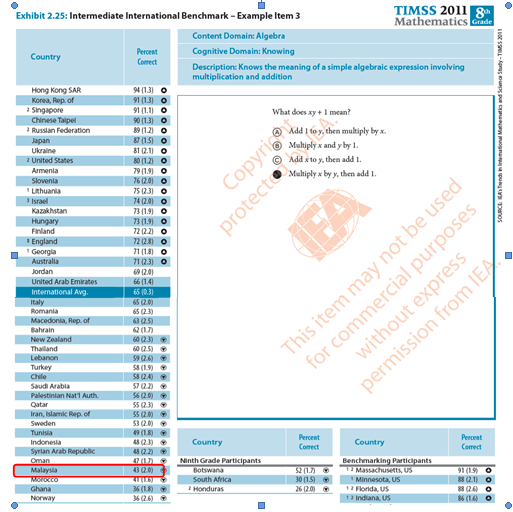
Prior to the TIMSS 2011 revelation, I had no idea that the standards of Maths and Science in Malaysia has shockingly plunged to such a pathetic level. Looking at the shiny results of our students in public examinations, who would have thought of the ugly truth concealed behind it. Obviously, the Ministry of Education has lowered the passing grades to give the impression of  a so-called "improvement", for whatever reasons that is. Just look at the 2012 PMR results for an instance. 24% of all candidates got an A in Science. Despite of how glorious this might make us feel, what use is this "glory" if these students cannot compete globally?

Now let's take a look at the real scenario, and judge for yourself.

Percentage of students who answered “What does xy+1 mean” correctly"


Percentage of students who answered “What is the chemical formula for carbon dioxide” correctly.


It's natural that when something bad happens, people will start pointing fingers. Instead of thinking of a solution, we are more interested in finding out who should take the blame. This time, instead of talking about the blame list, let's see what we can do now that our kids in school are no longer inclined to Maths and Science. Deputy Education Minister Datuk Wee Ka Siong said, "we will do something", but declined further comment. The government would study the report, identify Malaysia's weaknesses and take the necessary action.

I have some questions:
  1. Before the TIMSS report, does the government really have no idea of this declining trend? I doubt so.
  2. Why only now, when the dark secret has been revealed to the public, then only "the necessary action" is to be taken?

Perhaps this declining rankings has something to do with our overemphasis on what language should be used to teach Maths and Science. The PPSMI policy? Ring a bell? PAGE Malaysia chairman said:
"The government talks so much about science and innovation leading the country forward but this is not reflected in our education system. The focus has been too much on what language we will teach in. It is knowledge that will help us excel."
We should promote inquiry-based science education with an emphasis on getting students involved in laboratory experiments instead of merely learning from textbooks. Also, Malaysia should do a detailed analysis which will lead to an education reform if we are serious about reversing these plunging standards. We should perhaps start simply by telling the truth. Stop hiding facts and put more efforts on working together as a team, with the true 1Malaysia spirit. Stop pointing fingers, we all should take the blame. So let's contribute what we can to reverse the trends and show the world that Malaysia boleh!


Thursday, December 20, 2012

A Spicy Alternative in Education Reform


I wrote this post in response to this article on The Star. I have no idea what political motives lie beneath this action, therefore my writing is based solely on my personal account as an English teacher.

The Transformasi Pendidikan through Pelan Pembangunan Pendidikan Malaysia starting 2013 outlines the need for better-qualified teachers in our country. Based on the results of the Cambridge Placement Test conducted earlier this year, it was generalized that the number of teachers who are proficient enough to teach English is not enough to cater to the needs of the growing number of students that we have in our schools. These so-called 'incompetent' teachers will be sent on courses starting 2013 to improve their proficiency in English Language. While waiting for these teachers to become 'competent', a shortage of qualified English teachers is foreseen in our schools.

It is undoubted that this shortage requires a drastic action from the government, but I have a few questions in mind when the government decided to import English teachers from India to teach in our schools.


  1. Are these Indian teachers qualified (in terms of both English proficiency and teaching qualifications) to teach English? 
  2. If they are, on what basis and how better-qualified are they compared to our local teachers?
  3. Will they be required to take the Cambridge Placement Test prior to being exported to Malaysia?
  4. What are the measures that will be taken to ensure these teachers' full understanding of  the Malaysian education system and requirement?


I am not criticizing the government's action, but merely questioning whether this decision will ultimately benefit our students in schools. If these teachers are proven to be qualified based on the same standards required for local teachers, I have no issue against having them teaching English in Malaysia provided that they adhere to certain Malaysian standards. First, they have to fully understand the role of English in the Malaysian context as well as our education system which might differ from that of India. Second, they should be paid certain allowances but their salary should not differ greatly from that of our local teachers. They are, after all, non-native speakers like us.

Our Prime Minister, Dato' Seri Mohd Najib Tun Abdul Razak, suggested this idea to his Indian counterpart, Manmohan Singh who welcomed it and will instruct the relevant ministry to hold discussions with the (Malaysian) Education Ministry to realize this. According to Najib, Malaysia will receive teachers from India who are fluent in English to teach our students in Malaysia. Hopefully the Malaysian Ministry of Education will set a high standard on "how fluent is fluent" as fluency is rather subjective. Also, some teaching qualifications should also be considered as Najib also highlighted that this action "would enhance the Government's efforts to alleviate the shortage of English teachers and improve proficiency in the language."


Related Posts Plugin for WordPress, Blogger...